

The Nuremberg Celestial Phenomenon (1561): When the Sky Turned Strange
, by Carl Rogers
, by Carl Rogers
In the early hours of April 14th, 1561, the citizens of Nuremberg woke to something extraordinary — and unsettling. As dawn broke, the sky above the city reportedly filled with strange shapes, spheres, crosses, cylinders, and disc-like objects, appearing to move, collide, and fall from the heavens.
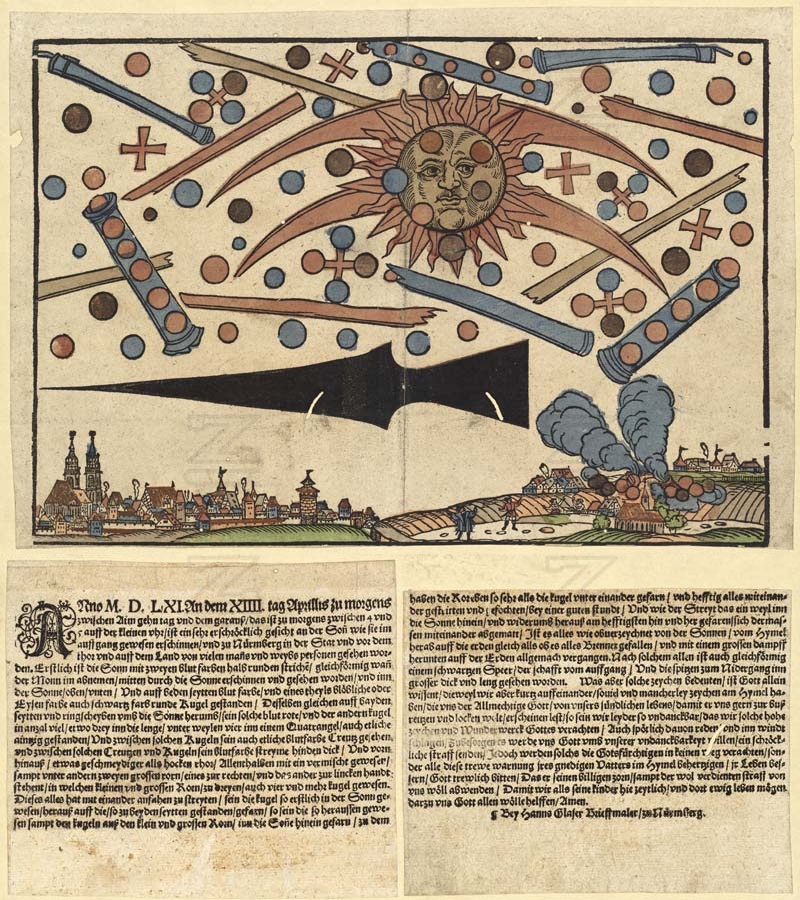
This wasn’t a whispered rumour or a single eyewitness account. It was documented, illustrated, and published within weeks — making it one of the most famous and puzzling mass sightings in recorded history.
According to the contemporary account, witnesses described a dramatic aerial display lasting for over an hour. Objects of different colours and shapes appeared to engage in what looked like a battle in the sky. Some were said to crash to the ground in smoke and fire beyond the city walls.
The event was recorded by Hans Glaser, a local printer, in the form of a broadsheet — the 16th-century equivalent of breaking news. His illustrated report shows:
Spheres and orbs
Cross-shaped objects
Long cylindrical forms
Disc-like shapes emerging from tubes
A large spear-shaped object dominating the scene
To modern eyes, the imagery feels eerily familiar.
In 1561, the language of the time framed unexplained events through a religious lens. Glaser interpreted the phenomenon as a divine sign or warning, urging repentance and reflection. That framing was expected — but the raw visual details of the account stand on their own.
What’s fascinating is how little embellishment there is. The report doesn’t describe angels or demons — it describes objects, movement, and interaction. For something supposedly symbolic, it reads remarkably observational.
Today, historians and researchers propose several explanations:
Atmospheric phenomena (such as sun dogs or halos)
Optical illusions amplified by fear or religious belief
Astronomical events misinterpreted by 16th-century observers
Or… something genuinely anomalous
For those exploring UAP history, the Nuremberg event stands out because of its mass witnesses, visual documentation, and specificity of description.
Unlike many historic sightings, this wasn’t a single light in the sky — it was a complex, dynamic event witnessed by an entire city.
What makes this sighting so compelling isn’t just its age — it’s how closely it mirrors modern UAP reports:
Multiple object types
Structured movement
Apparent interaction or conflict
Public, daylight visibility
Strip away the woodcut and the religious interpretation, and the core experience feels surprisingly contemporary.
It raises a quiet but powerful question:
If people saw something they couldn’t explain in 1561… what does that say about what we’re seeing today?
At our core, this collection is about documented moments that challenge accepted history. The Nuremberg sighting isn’t science fiction. It’s a recorded anomaly, preserved in ink and woodcut, waiting to be re-examined.
When you wear designs inspired by events like this, you’re not wearing a theory — you’re wearing a question.
And some questions refuse to stay buried.


